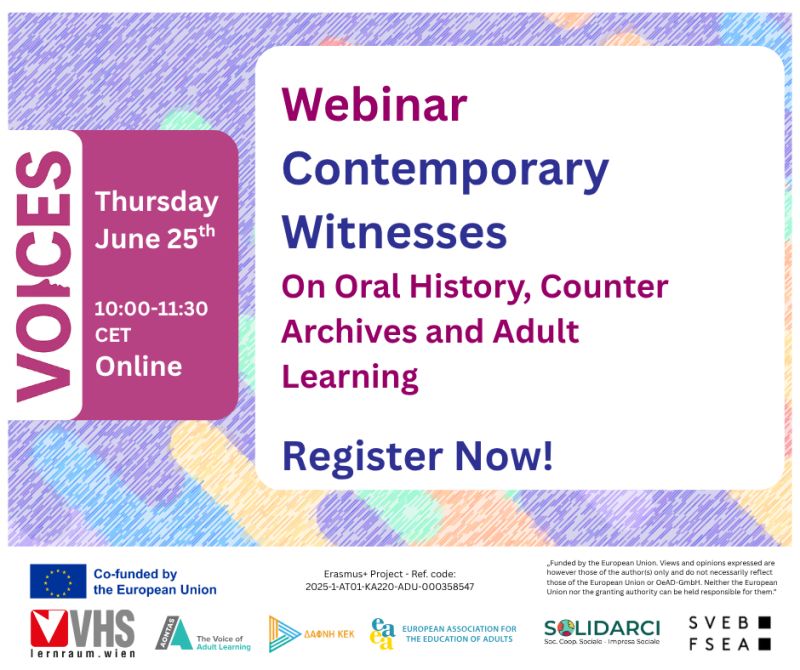

Contemporary Witnesses| On Oral History, Counter Archives and Adult Learning
Date: 25/06/2026
Time: 10am Central European Time
The webinar is organised within the VOICES project and is essentially a discussion about Counter Archives, historical “knowledge” and its communication in Adult Education. The event aims to raise awareness of (European) history, strengthen political awareness and education, address “radicalisation”, and promote inclusion within civil society.
The panel discussion on “Contemporary Witnesses| On Oral History, Counter Archives and Adult Learning” will discuss how the authentic spoken testimonies of learners with migration experience – from the 1950s to the present – can serve as powerful entry points not only for enhancing one’s relation with their own and/or everyday language(s), but also for critically engaging with sociopolitical events and mainstreamed narratives.
The discussion will focus on:
- how counter-archives and oral history methods challenge dominant historical narratives;
- the role of spoken testimonies, memory, and intergenerational transmission in adult learning;
- inclusive approaches to literacy, memory, and historical knowledge that centre migration as a lived experience from 1950s to today;
- and how these topics can be meaningfully communicated in Adult Education settings across Europe.
The webinar is expected to gather around 20 participants, including trainers, civil society organisations, EU-level NGOs, policymakers, researchers, and community organisers. It will also include an interactive exchange and Q&A session with participants.
Preliminary agenda
| Time/Theme | Description | Responsible |
|---|---|---|
| 10min – Welcome and introduction | European Association for the Education of Adults (EAEA), as the lead organization for WP 2.4, should open the event. The webinar will be recorded so that it can be published and made freely available later. Brief introduction to the VOICES project and state the webinar’s overarching goals: to raise awareness of European history, boost political awareness and education, prevent radicalization, and promote inclusion within civil society. | Host/Moderator: European Association of the Education of Adults (EAEA) |
| 15min – Keynote “Oral History and Contemporary Witnesses for Language Learning” | Focus on oral history in this first Webinar. We need a kind of framework to work within Discussing how to successfully integrate the methodology of oral history into second language learning and basic adult education courses – Internal Keynote (VHS Vienna): To introduce VOICES research document | Keynote Susanne Klingseis – VHS lernraum.wien |
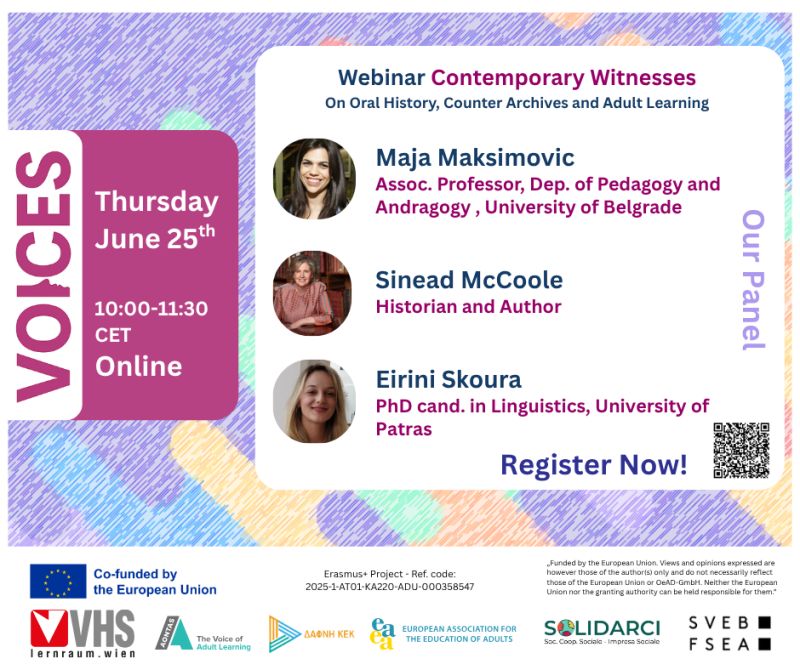
| 30min – Panel discussion “Counter Archives and Historical Knowledge” | A deep dive into the concept of “Counter Archives”—how they challenge traditional narratives—and a broader discussion on what constitutes historical “knowledge” and how it should be communicated in Adult Education (AE). | Panel participants Maja Maksimovic – Associate Professor at the Department of Pedagogy and Andragogy, Faculty of Philosophy, University of Belgrade Sinead McCoole – Writer/Historian Eirini Skoura – PhD candidate in Linguistics at the University of Patras, Greece |
| 20min – Interactive Exchange and Q&A | The webinar is expected to host around 20 participants, specifically targeting trainers, stakeholders, civil society organizations, EU-level NGOs, policymakers, and community organizers. Activity: Open the floor for an active exchange of ideas, allowing these stakeholders to network, ask questions to the experts, and discuss how to outreach this topic across Europe. | Webinar Participants |
| 10min – Conclusion and Evaluation | EAEA and partner organizations provide closing remarks. Evaluation (interactive feedback survey) | EAEA & partners SOLIDARCI |
More information
——- Speakers’ short bios ——-
Maja Maksimovic
Maja Maksimović, PhD, is an Associate Professor at the Department of Pedagogy and Andragogy, Faculty of Philosophy, University of Belgrade. Her work explores the intersections of education, activism, and the arts, with a focus on developing critical, embodied, spatial, and imaginative approaches to research and practice. She is a member of the Steering Committee of the European Society for Research on the Education of Adults (ESREA) and co-convener of its Active Democratic Citizenship and Adult Learning network. She serves as editor of Andragogical Studies and is one of the editors of the European Journal for Research on the Education and Learning of Adults. Her recent book, Landscapes of Learning: Relations of Place, Knowledge and Artistic Practices, was published in 2025.
https://scholar.google.ca/citations?user=qaixetMAAAAJ&hl=en
Eirini Skoura
Eirini Skoura is a PhD candidate in Linguistics at the University of Patras, Greece, specializing in migration narratives and public discourse analysis. Her research explores how migration is represented in political, media, and institutional discourses, and how these representations shape public understandings of migration and social diversity. She is particularly interested in the relationship between discourse, social inequalities, and education, as well as in translating research findings into educational practice through critical literacy initiatives. She is a doctoral fellow of the Hellenic Foundation for Research and Innovation (HFRI).
www.researchgate.net/profile/Eirini-Skoura
Sinead McCoole
Sinéad McCoole is an Irish historian, author, broadcaster, script writer, historical and picture researcher and exhibition curator. Sinéad is the author of Easter Widows on the widows of the men executed in the 1916 Rising, published by Doubleday Ireland. As a Curator, she has originated and collaborated on a number of important exhibitions both in Ireland and the US. Her areas of expertise include The Rising, the War of Independence, and Civil War (with an emphasis on the role of women).Sinead is also the Head of Exhibitions, Learning and Programming at the National Library of Ireland.
Sinéad McCoole – Irish Writer/Historian
Susanne Klingseis
Studied political science (with a focus on gender studies, racism, and postcolonial theories) at the University of Vienna; earned a degree in academic NPO management (FH Vienna).
Additional areas and activities:
German as a Second Language, Pedagogy, Migration education, Trauma-Informed Education, Psychotherapist (in Training under Supervision)
https://www.vhs.at/de/e/lernraum-wien
——- PDF Files ——-
——- Graphics ——-